
Microdosing and Sleep
Why a morning microdose can quietly compress the night that follows, what the receptor pharmacology suggests, and how caffeine compounds the effect.
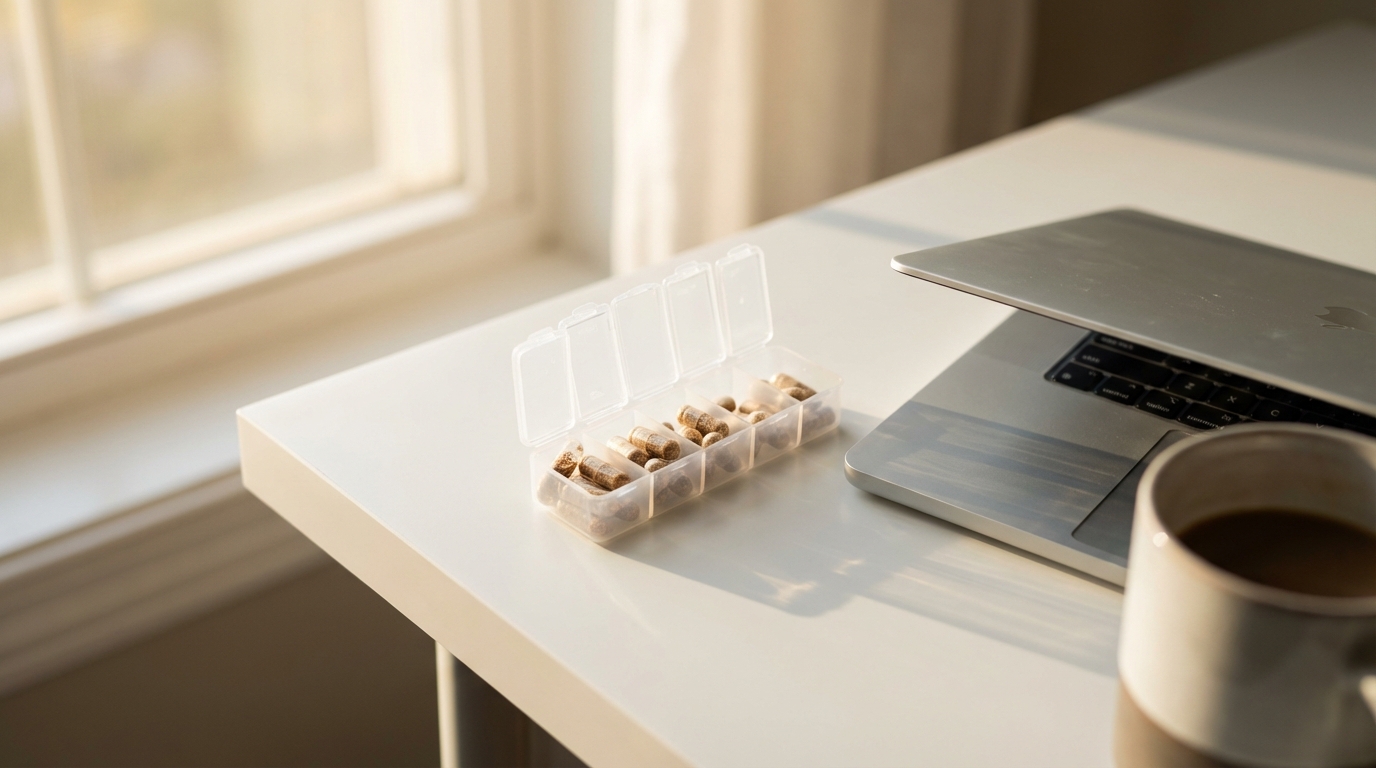
One of the most consistent reports from people who microdose is also one of the least talked about: a morning dose can quietly compress the night that follows. Lighter sleep, earlier waking, less time in the deeper stages. The pattern is reliable enough that it shows up across protocols, across substances, and across very different kinds of nervous systems.
This is not a reason to stop. It is a reason to pay attention to a piece of the puzzle that most popular writing on microdosing skips over.
What seems to be happening
Both psilocybin and LSD act on serotonin 5-HT2A receptors, which are involved in mood, perception, and arousal. Even at low doses, that engagement appears to shift the system toward wakefulness rather than away from it. The subjective experience during the day is often described as a mild upshift, more energy or focus or emotional availability. The night-time correlate is the same upshift expressed as harder-to-reach sleep depth.
LSD has a long pharmacokinetic tail. Effects can persist for six to ten hours after ingestion, which means a dose at 7am can still be doing something at 5pm. Psilocybin clears faster, but the stimulant quality often outlasts the strict pharmacokinetics, suggesting that what disrupts sleep is not the molecule still circulating but a system that has been left in a slightly elevated state.
Several mechanisms have been proposed: residual 5-HT2A activity nudging arousal upward, downstream effects on the default mode network that reduce the brain's willingness to settle into low-frequency rhythms, or a more general sympathetic-nervous-system tilt that takes hours to resolve. None of these is fully nailed down. The pattern, however, is replicable enough across self-reports to take seriously.
What people typically notice
The most common sleep changes reported are some combination of:
- ●Earlier waking than usual, often by 60 to 120 minutes
- ●Lighter sleep, with more frequent micro-awakenings
- ●Less time in slow-wave or REM sleep, even when total time in bed is similar
- ●A faster return to mental alertness on waking, with less of the usual sleep inertia
Importantly, this pattern is usually transient. Sleep typically returns to baseline within a night or two of the next non-dosing day. What people describe as "microdosing ruining my sleep" almost always means: dosing days bring shorter or lighter sleep; rest days do not. That is a real cost, but it is not a permanent disruption.
The exception worth naming is the more aggressive stack. People on a Stamets-style four-on, three-off cadence sometimes report a cumulative drift over the four dosing days, with each night a little lighter than the last. The Fadiman cadence with its two rest days tends to allow more recovery between doses.
How caffeine compounds it
Most people who microdose also drink coffee. The combination is so common that it is rarely examined as a variable, but it is probably the single largest contributor to sleep disruption on dosing days.
Caffeine raises cortisol, adrenaline, and dopamine. Microdosed psilocybin or LSD raises serotonin signaling and engages 5-HT2A receptors. Each one alone produces some upshift in the system. Taken together, they appear to produce more upshift than either does alone, and the combined effect lasts longer.
The practical signature is this: more arousal during the day than caffeine alone produces, less ability to wind down in the evening, and a sleep that is shorter or lighter than the dose alone would account for.
If you microdose and you also drink coffee, run the experiment at least once with reduced or delayed caffeine. The cleanest test is a dosing day with no caffeine until after lunch, or with the second cup dropped entirely. If sleep improves, you have learned something about your stack that will inform the rest of your inquiry.
What tends to help
A short list of adjustments that often shift the pattern:
- ●Take the dose early. Before 8am if you can, certainly before 9am. The window between dose and bedtime needs to be as long as possible.
- ●Reduce or shift caffeine on dosing days. One coffee instead of two, or matcha instead of coffee, or both moved to before 10am. The change does not need to be permanent; it is part of the experiment.
- ●Skip late-day stimulation of any kind on dosing days: hard workouts after 5pm, screens late into the evening, late meals.
- ●Add wind-down practices that reach the parasympathetic system: slow breathing, magnesium, dim light, a warm shower. These are not microdosing-specific; they are baseline sleep hygiene that becomes more useful when the day has tilted toward arousal.
- ●Consider a less stimulating protocol. The intuitive or once-weekly cadence usually disrupts sleep less than the Fadiman protocol; the Fadiman cadence usually disrupts less than the Stamets stack.
When it is not transient
Most sleep changes on microdosing days resolve within a night or two. A few patterns are worth pausing on:
- ●Sleep that does not return to baseline on rest days. If your sleep is degraded across the whole week, not just dosing nights, the practice is asking more of your system than it can absorb.
- ●Anxiety or emotional volatility that emerges alongside the sleep change. Sleep loss compounds whatever else is happening; if mood is also unstable, those two things will continue to amplify each other.
- ●A pattern of needing to dose more often to feel the same effect, with sleep getting worse in parallel. That suggests tolerance accumulation and is a reason to take a longer break, not to push through.
If any of these is what you are noticing, the right move is usually to pause for two to four weeks and re-establish a sleep baseline before deciding whether to resume.
The bigger frame
Microdosing exists in a conversation with sleep that most popular writing has not caught up to. The dominant cultural narrative emphasizes mood and focus benefits during the day; the receipts on the night side of the ledger are quieter and less visible.
The honest summary is this: a microdosing practice that consistently degrades your sleep is not a sustainable practice, regardless of what it appears to be doing during the day. Sleep is not optional infrastructure; the gains of the practice cannot exceed the losses if those losses are coming out of the part of the day that consolidates memory, regulates mood, and resets the nervous system.
The good news is that for most people, with attention to timing and caffeine, the sleep cost is manageable. The work is to notice it, name it, and treat it as a variable in the experiment rather than a side-effect to ignore.
Considerations
- ●If you have an existing sleep disorder, microdosing is probably not the right experiment to run. The interaction between low-dose psychedelics and disordered sleep is poorly understood and the downside is significant.
- ●People taking SSRIs, MAOIs, lithium, or other psychiatric medications should discuss interactions with a clinician before microdosing. Some combinations carry real risks beyond the sleep question.
- ●Sleep tracking with consumer wearables can be informative but is also error-prone. Trust the subjective signal (do you feel rested) at least as much as the device's score.
- ●Caffeine sensitivity varies widely with genetics. If you metabolize caffeine slowly (a CYP1A2 allele variant), the compounding effect with a microdose is likely to be larger than for someone who clears caffeine quickly.