
Common Microdosing Stacks
The combinations people actually use, what each is meant to do, and where the evidence is thinner than the conversation suggests.
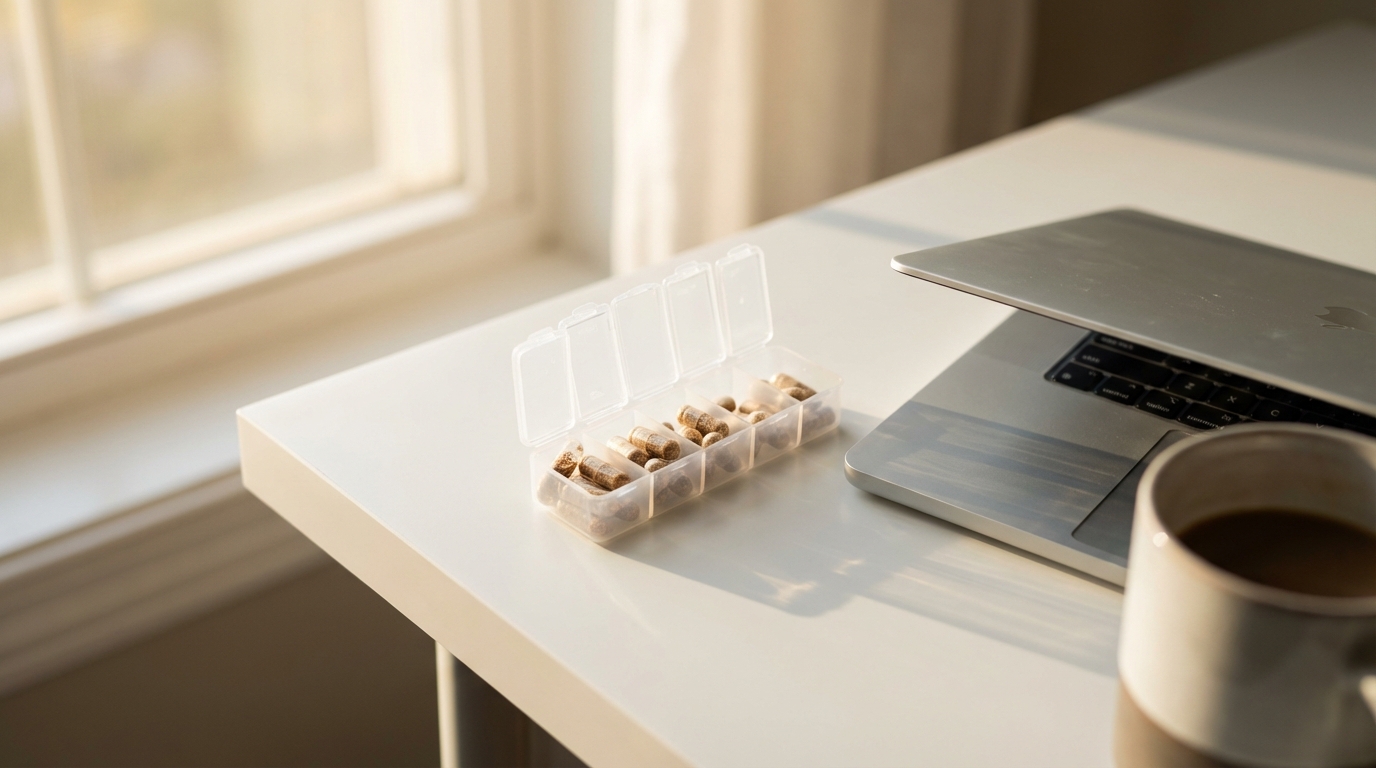
Once a microdosing practice is underway, the question of what to combine it with tends to surface fairly quickly. The community conversation has converged on a handful of stacks: the Stamets combination, caffeine pairings and substitutions, and a few less-discussed additions like cacao or rhodiola. Each one has a rationale. Some have decent evidence. Most do not.
What follows is a survey of the most common combinations, what each is built for, and where the gap between the claim and the data sits.
The Stamets stack
The most cited combination. Paul Stamets proposed pairing psilocybin with two non-psychedelic compounds:
- ●Lion's mane (Hericium erinaceus). A functional mushroom with proposed neuroprotective and neurogenic properties. The active compounds, hericenones and erinacines, can cross the blood-brain barrier and have been shown in some preclinical work to promote nerve growth factor expression. Human evidence is thinner; small trials suggest possible cognitive support in older adults with mild impairment, but the broader claims about neurogenesis in healthy adults rest on extrapolation rather than direct findings.
- ●Niacin (vitamin B3, in the flushing form). The role attributed to niacin is to produce a peripheral vasodilation that helps distribute the active compounds. The flush is real, the distribution rationale is plausible, the actual contribution to subjective effects has not been carefully tested.
The full stack is usually taken on a four-days-on, three-days-off cadence, which is itself part of what defines it as the Stamets protocol rather than a generic combination.
The stack is widely discussed and widely tried. It has not, however, been tested in controlled trials as a combined protocol. The synergistic claims rest on the plausibility of each component independently rather than on direct evidence of the three working together. That does not make them wrong. It does mean the stack is best understood as a structured hypothesis rather than a validated formula.
If it appeals to you, treat it as you would any other variable: introduce it deliberately, track what changes, and consider whether the effects are different from what the protocol alone would produce.
Caffeine: the unintentional default stack
For most people, the question is not whether to add caffeine. The question is whether to keep the caffeine that is already there.
Coffee and microdosing combine more than the popular conversation acknowledges. Both raise arousal. Both engage neurotransmitter systems involved in attention and mood. The combined effect appears to be larger and longer-lasting than either alone, with the cleanest signature in disrupted sleep that night.
Two practical paths exist:
- ●Reduce or delay. One cup instead of two. Both cups before 10am. Caffeine moved to after 1pm. Each of these tends to shift the sleep impact noticeably.
- ●Substitute. Matcha or green tea provides a gentler, longer-arc caffeine profile alongside L-theanine, which appears to take some of the edge off. Many people who microdose move toward matcha during dosing weeks even if coffee remains the rest of the time.
Whether to drop caffeine entirely on dosing days is worth experimenting with at least once. It is the cleanest test of how much of the day's character is the microdose and how much is the combination.
Cacao
Less common, more ceremonial in its origin. Ceremonial cacao (high-percentage, minimally processed) is sometimes paired with low doses of psilocybin in a heart-opening, presence-oriented context. The pairing has roots in Mesoamerican traditions where cacao was used as a sacred plant in its own right, and contemporary practitioners have adapted it for microdosing settings.
The pharmacological case is mild. Cacao contains theobromine (a milder cousin of caffeine), small amounts of phenylethylamine, and anandamide-related compounds. It can produce a gentle warming and an opening of the cardiovascular system without the sharp arousal of coffee. Combined with a microdose, the effect tends to be more gentle and emotional than the cognitive uptick of a coffee pairing.
The risk to flag is that ceremonial cacao at the doses used in some practices (40g and up) can produce noticeable cardiovascular effects on its own. Combined with a microdose, the load on the system is non-trivial, and people with heart conditions or who take SSRIs should be careful.
Lion's mane alone
Without the rest of the Stamets stack. Some people use lion's mane on its own as an everyday supplement and add a microdose periodically. The combination is much milder than the full stack and easier to assess: lion's mane has its own mild cognitive signal in some people and its own absence of signal in others, and the microdose adds whatever it adds on top.
If you are curious about lion's mane, it is probably more informative to take it alone for a few weeks before combining. Otherwise, you cannot tell what is doing what.
Rhodiola, ashwagandha, and the adaptogen tier
Adaptogens (rhodiola, ashwagandha, ginseng, eleuthero) are sometimes paired with microdosing as a stress-buffering layer. The rationale is that adaptogens modulate the HPA axis (the body's main stress response system), and a microdose tends to push arousal upward, so combining them is meant to keep the upshift focused without spilling into anxiety.
The evidence for adaptogens varies considerably by compound, dose, and outcome. Rhodiola has reasonable data for fatigue and mild mood support. Ashwagandha has data for stress and sleep. Ginseng is more mixed. None of these have been studied in combination with microdosing.
If an adaptogen is already part of your routine, keeping it through a microdosing period is usually fine. Adding one specifically for the microdosing context is a less clear win.
Cannabis (almost always not)
Cannabis interacts with microdosed psilocybin or LSD in ways that are usually unhelpful. THC tends to amplify whatever the microdose is doing, often pushing the experience past sub-perceptual into low-dose territory without the user realizing the threshold has been crossed. The combined effect on sleep, anxiety, and short-term memory tends to be worse than either substance produces alone.
A few exceptions exist. Some people use small amounts of CBD (without THC) to take edges off occasional anxiety on dosing days, and that combination appears to be benign. Beyond that, cannabis is the stack ingredient most often listed as a thing-to-not-do in practitioner accounts of what went wrong.
Antidepressants (the medical conversation)
Many people who try microdosing are also on SSRIs or SNRIs. The interaction is real and the literature is incomplete. The most-discussed concerns are reduced subjective effect of the microdose (because SSRIs occupy the same receptor system that the psychedelic acts on) and theoretical risk of serotonin syndrome at higher doses.
For microdoses specifically, serotonin syndrome appears to be a low-probability event but is not zero, and the question of reduced effect is real enough that some people on SSRIs find microdosing essentially does nothing.
This is the stack question that most reliably benefits from a clinician's input. Whatever the pharmacology turns out to be, the answer is not findable through self-experimentation alone.
How to think about combinations
A few habits that tend to make stack inquiries more useful:
- ●Add one variable at a time. If you want to try lion's mane, add it for a few weeks before adding niacin. If you want to drop caffeine, drop it before adding anything new.
- ●Track for at least four weeks before drawing conclusions. The week-to-week noise in mood, sleep, and energy is often larger than the signal you are trying to detect.
- ●Notice your baseline. Some of the effects attributed to a stack are actually the absence of the worse effects of the unstacked version (less anxiety because sleep is better, not because the stack itself is doing something).
- ●Be willing to subtract. Most people end up with a simpler stack than they started with. The interesting work is figuring out what is actually contributing.
Considerations
- ●Stacking is a load on the system. Even benign combinations add up. If the practice is producing noticeable benefit on its own, adding things rarely improves it as much as a cleaner inquiry would.
- ●The legal status of microdosing remains a constraint that shapes everything else. The substances and doses cannot be reliably verified in most jurisdictions, which means stack effects are doubly difficult to attribute.
- ●Pre-existing cardiovascular conditions are a serious consideration when adding niacin (vasodilation), high-dose cacao, or stimulant adaptogens like ginseng to a microdose.
- ●The combinations most worth taking seriously, from a safety and signal standpoint, are usually the ones with the longest history outside the microdosing context. Lion's mane, matcha, and adaptogens existed as their own practices long before they were paired with psilocybin. The newer the stack rationale, the thinner the evidence tends to be.