
Henbane is an ancient Mediterranean nightshade used in oracles and witchcraft, whose deliriant tropane alkaloids blur the line between sleep, vision, and waking consciousness.
Henbane
Henbane is an ancient Mediterranean nightshade used in oracles and witchcraft, whose deliriant tropane alkaloids blur the line between sleep, vision, and waking consciousness.
Fact file
- Type
- Plant
- Botanical name
- Hyoscyamus niger
- Other names
- Black henbane, henbane, Egyptian henbane, hog's bean
- Origin
- Mediterranean and Western Asia
- Duration
- 6-12 hours
- Strength
- Intense
- Legal status
- Illegal in 25 of 30 listed jurisdictions, and varies elsewhere
What is Henbane?
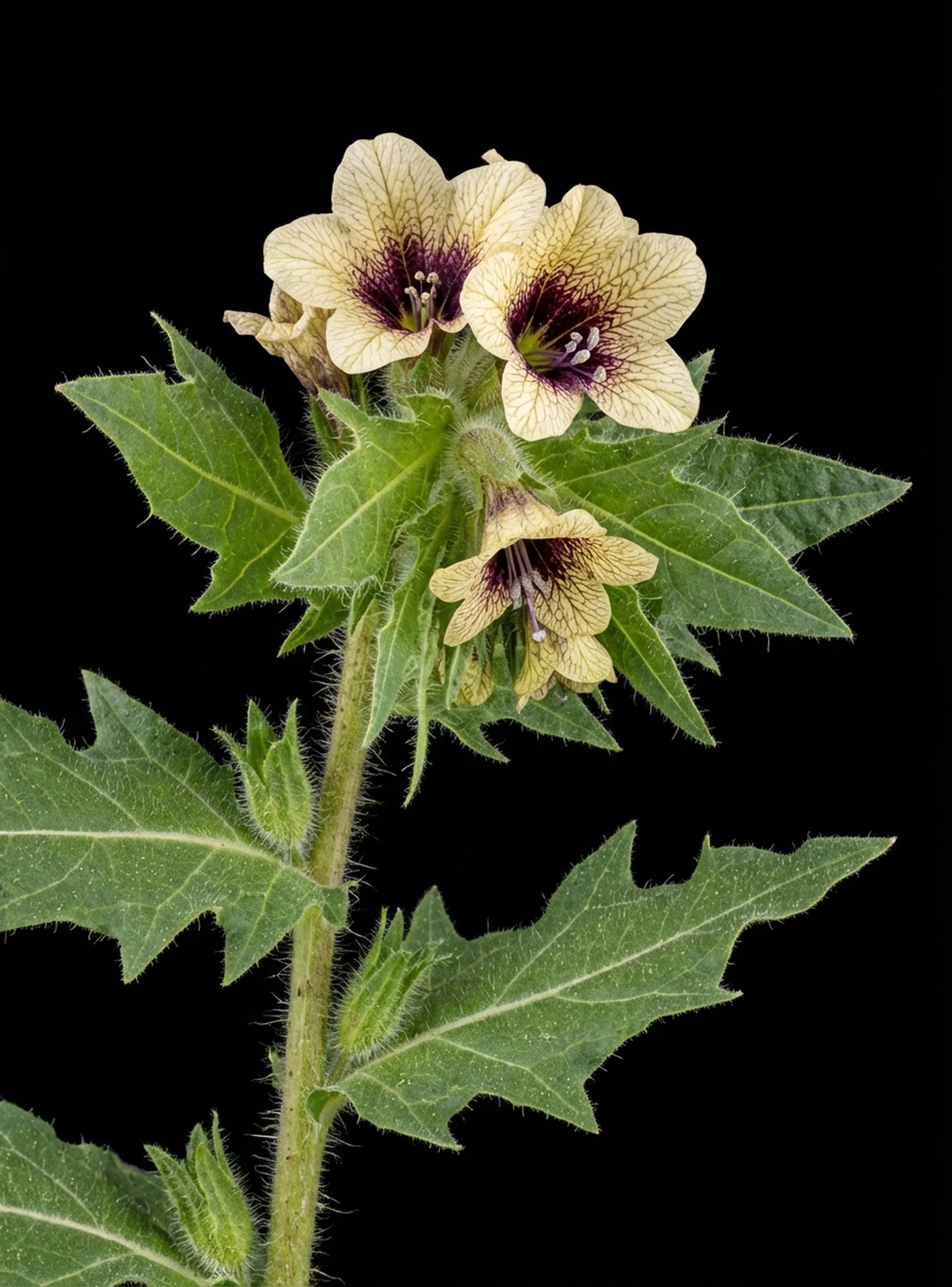
In the waste ground at the edge of old villages, a sticky, foul-smelling plant opens pale yellow flowers veined in purple, each one a map of capillaries drawn by no human hand. Hyoscyamus niger is one of the oldest psychoactive plants in European history, threaded through Greek oracles, Norse shamanism, and the confessions of accused witches. It is also, by most accounts, deeply unpleasant to experience.
Henbane does not illuminate consciousness. It dismantles it. Where serotonergic psychedelics reshape perception while leaving the observer mostly intact, henbane erases the observer. It blocks acetylcholine, the neurotransmitter that holds together memory, attention, and the quiet, continuous work of knowing what is real. The result is not vision but delirium, not insight but a state in which hallucinations arrive as literal events, unrecognized as products of the mind.
This is a plant that has been feared for millennia, and the fear is earned. It belongs to the nightshade family alongside belladonna and Datura, a lineage defined by narrow margins between experience and emergency. To study henbane is to ask what it means that some of humanity's earliest spiritual technologies were built on terror, amnesia, and the deliberate dissolution of ordinary knowing.
Identity
Scientific name: Hyoscyamus niger L. (Linnaeus, 1753)
Common names: Black henbane, hog's bean, Egyptian henbane. In German: Bilsenkraut. In Arabic: sakran, banj. In Sanskrit: parpataka. The Latin insana ("madness plant") captures what historical observers found most striking.
Classification: A herbaceous annual or biennial in the Solanaceae (nightshade) family, sharing its lineage with Datura, belladonna, and the familiar tomato. The genus Hyoscyamus includes roughly 11 species, with H. niger the most widely distributed and pharmacologically characterized. Related species include H. albus (white henbane, Mediterranean) and H. aureus (golden henbane, Levantine).
Substance type: Plant. Its psychoactivity arises from tropane alkaloids, primarily scopolamine and hyoscyamine. These are anticholinergic compounds, pharmacologically opposite to the serotonin-based psychedelics. Where psilocybin activates receptors, henbane's alkaloids block them.
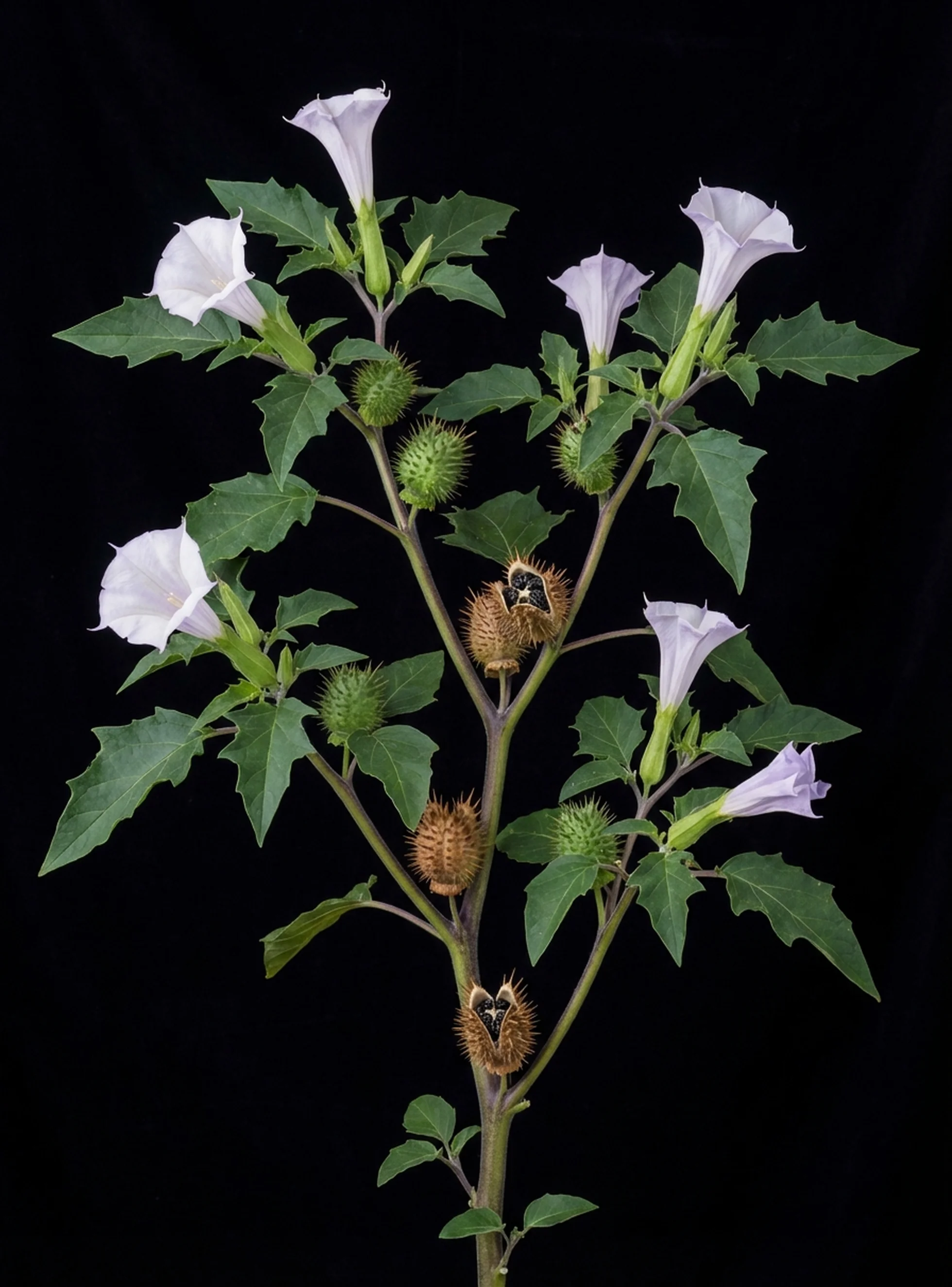
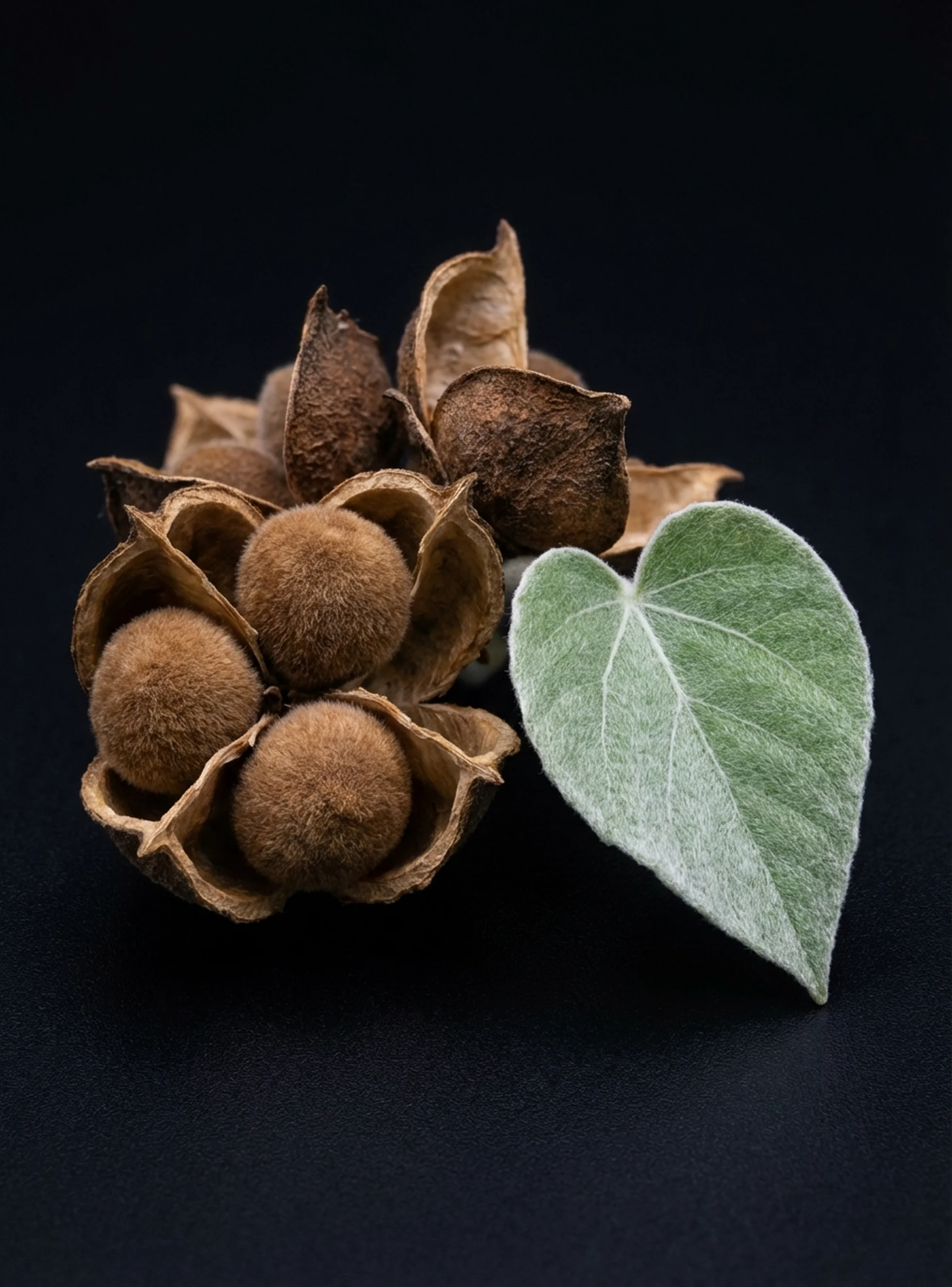
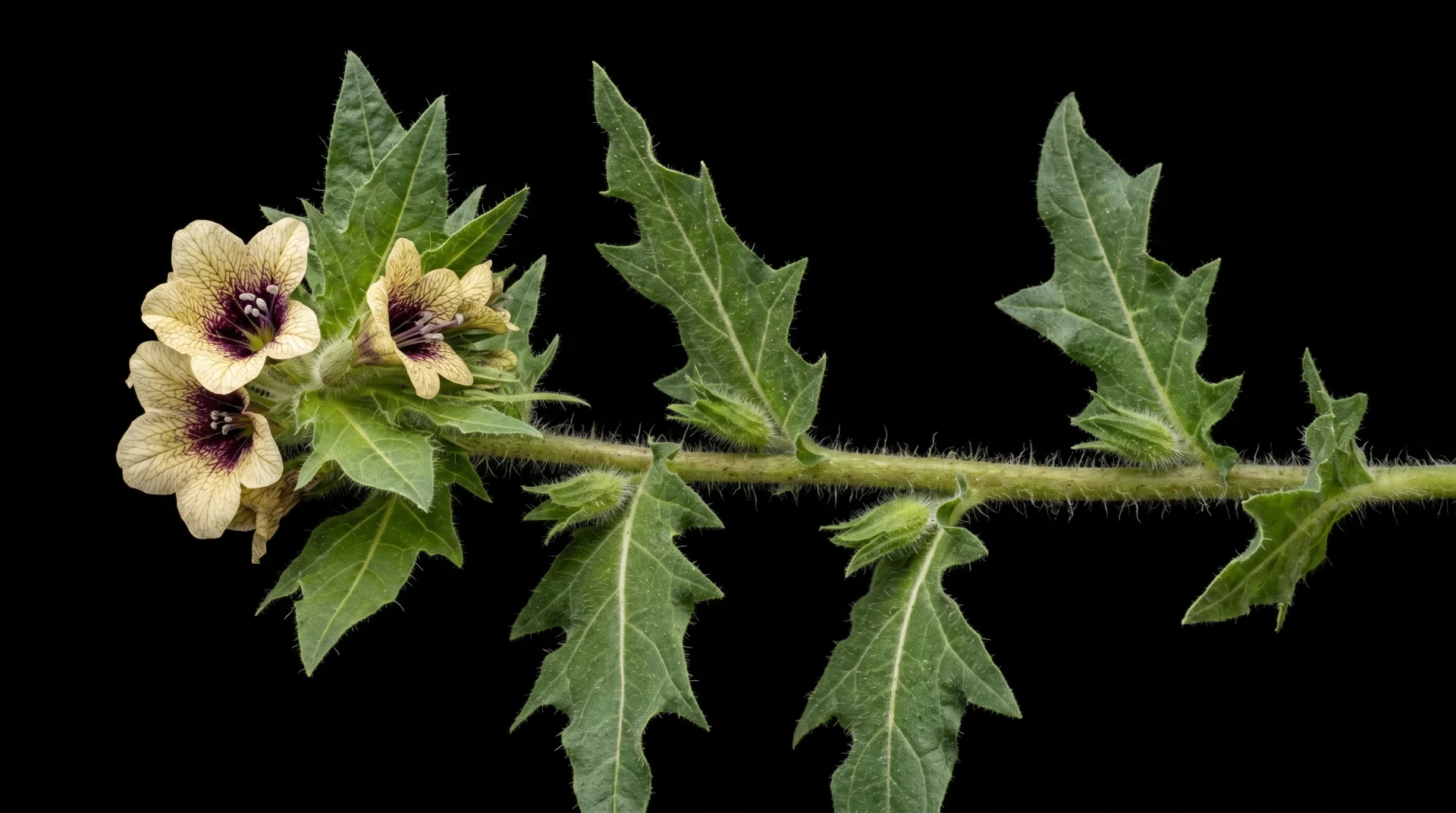
Distinguishing features: A plant 30 to 60 centimeters tall, entirely covered in glandular hairs that produce a characteristic acrid, urine-like smell. The flowers are unmistakable: pale yellow petals laced with dark purple veining in a net-like pattern. The seed capsule sits inside an enlarged calyx, resembling a small urn. Easily confused with Datura (thornapple), which has spiny seed pods and trumpet-shaped flowers without veining.
Strength and duration
Intensity profile
Duration
Aftereffects: ** - Residual confusion, disorientation, emotional numbness: 2–6 hours post-baseline return - Persistent dry mouth, mild tremor: 4–8 hours - Cognitive/emotional integration difficulties, fragmented memories: 12–24 hours - Full autonomic recovery: typically by 12–18 hours [1][11]
Chemistry
Henbane's psychoactivity rests on two primary tropane alkaloids: scopolamine (hyoscine) and hyoscyamine. Both are competitive antagonists at muscarinic acetylcholine receptors (M1 through M5), meaning they block one of the brain's most essential signaling systems.
Acetylcholine governs memory consolidation, sensory filtering, attention, and the autonomic functions that regulate heart rate, body temperature, and digestion. When henbane's alkaloids occupy these receptor sites, the effects cascade across the entire nervous system. The hippocampus loses its ability to form new memories. The cerebral cortex, deprived of its primary regulatory signal, generates delirium and hallucinations. The autonomic nervous system tips into overdrive: heart rate climbs, pupils dilate maximally, sweat glands shut down, and the body loses its ability to regulate temperature.
Scopolamine (approximately 0.4 to 0.5 percent of dry plant weight) crosses the blood-brain barrier more readily than hyoscyamine, making it the primary driver of central effects: the delirium, the hallucinations, the amnesia. Hyoscyamine (0.1 to 0.3 percent) contributes a paradoxical biphasic profile. At lower concentrations, it produces stimulation (increased alertness, tremor), while higher concentrations produce sedation. This shift reflects differential receptor occupancy: early engagement of M2 autoreceptors creates a brief disinhibitory effect before full M1/M3 blockade takes hold.
Secondary compounds include atropine (the racemic form of hyoscyamine, formed during drying and storage), trace amounts of apoatropine, and the calystegines (polyhydroxylated alkaloids that inhibit certain enzymes but do not contribute to the psychoactive experience).
Alkaloid concentrations vary 6 to 12 fold between individual plants, depending on growth stage, harvest time, plant part, and environmental stress. Leaves carry the highest concentration; drought increases alkaloid production. This variability is not incidental. It is the central pharmacological fact about henbane, and the primary reason that standardizing any encounter with the raw plant is effectively impossible.
The metabolic pathway follows a predictable course. Oral absorption through the small intestine produces peak plasma levels in 1 to 2 hours. Both alkaloids are hydrolyzed by hepatic esterases. Scopolamine has an elimination half-life of roughly 5 to 6 hours; hyoscyamine clears in about 3.5 hours. Total alkaloid clearance is typically complete within 24 to 48 hours.

Methods of Encounter
Intentional encounters with henbane are rare in modern contexts. The plant's severe unpleasantness, unpredictable potency, and the availability of safer alternatives mean that most contemporary exposures are accidental: foragers mistaking henbane for an edible species, or agricultural workers handling contaminated grain.
Historically, the plant was encountered through three primary routes, each shaping the experience distinctly.
Oral ingestion (ground leaf, tea, or decoction) was the most common intentional route. Onset arrives in 20 to 60 minutes. Peak effects build over 1 to 3 hours. Total duration stretches to 8 to 16 hours, reflecting slow absorption and the plant's own anticholinergic effects on digestion. The prolonged plateau tends to produce sustained periods of terror.
Inhalation (smoke from dried leaves) produced the most rapid onset: 5 to 15 minutes, as alkaloids bypass first-pass liver metabolism and absorb directly through the lungs. The total experience runs 3 to 8 hours. The sudden transition into delirium often feels more shocking and less controllable than oral ingestion.
Transdermal application (poultice or oil-infused cloth) was the route described in European witchcraft traditions and preferred in historical medical contexts. Onset is gradual, 30 minutes to 2 hours, with a sustained plateau as the skin acts as a slow-release depot. This route tends to produce more somnolence and less acute terror. Removing the application stopped further absorption, giving practitioners a degree of control.
In traditional contexts, Germanic seidr practitioners, Greek oracular priestesses, and Islamic physicians each developed distinct relationships with the plant. Modern clinical use is limited to pharmaceutical scopolamine (transdermal patches for motion sickness), standardized and precisely dosed, bearing little resemblance to the whole plant.

Origin & History
Henbane's oldest home is the Eastern Mediterranean, the Levantine coast, the dry hills of Anatolia, the lands surrounding the Fertile Crescent. By 3000 BCE it had spread across the Mediterranean basin and into Central Europe, traveling with human agriculture, a plant of disturbed soil and field margins that followed wherever people turned the earth.
The earliest archaeological traces come from Catalhoyuk in modern Turkey, where phytoliths consistent with Hyoscyamus appear in vessel residues dating to approximately 7500 BCE. Whether these reflect medicinal use, spiritual practice, or something more pragmatic remains unclear. What is clear is that the relationship between this plant and human communities is older than written language.
By the time Dioscorides documented henbane as hyoscyamos in his Materia Medica around 50 CE, the plant already carried millennia of accumulated knowledge. Greek physicians recognized its power to induce trance and sleep. At the Delphic Oracle, the Pythia may have inhaled preparations containing henbane to achieve prophetic states. At Eleusis, initiates entered ritually managed hallucinogenic experiences, and henbane remains a leading candidate among the plants involved.
In Northern Europe, the plant wove itself into a different tradition. Henbane seeds appear in Iron Age burial contexts across Scandinavia (400 BCE to 400 CE), and the archaeological record from Gotland and Jutland points clearly to ritual use. The volvas, female shamanic practitioners who performed seidr, likely used henbane to enter oracular trance states, crossing between worlds to obtain hidden knowledge.
The Medieval period brought persecution. Henbane became an ingredient in the "flying ointments" described in witch-trial testimony. Between the 1400s and 1700s, knowledge of such plants became evidence of maleficium. An estimated 40,000 to 60,000 people were executed as witches in Europe, roughly 75 to 80 percent of them women. How much of the recorded henbane use was genuine and how much was fabricated under torture remains one of the more troubling questions in the history of European pharmacology.
The nineteenth century began the slow work of translation from persecution to chemistry. In 1833, Auguste-Francois Cahours isolated hyoscyamine. By 1906, scopolamine was fully characterized. The compounds that had fueled oracles and condemned witches became pharmaceutical tools, pressed into service against motion sickness and surgical nausea.
As of 2026, henbane occupies an unusual position: extensively documented, rarely sought. A plant whose history is inseparable from the human desire to see beyond ordinary perception, and from the consequences of that desire.

Effects
The henbane experience resists tidy description. Alkaloid content varies 6 to 12 fold between individual plants, individual sensitivity differs widely, and the anticholinergic mechanism produces a state that is, by definition, poorly remembered by the person going through it. A fundamental distinction shapes everything: henbane is a deliriant, not a psychedelic. Where psilocybin or LSD alter perception while preserving the observer's awareness that perception is being altered, henbane dissolves that awareness itself. Hallucinations arrive as literal events, unrecognized as products of the mind.
Perceptual: 8/10
The hallucinations tend to be complex, immersive, and threatening: distorted figures, grotesque faces, shadowy presences, spaces that do not exist. Unlike the luminous geometry of serotonergic psychedelics, these have a grim, fevered quality, often described as watching a horror film while partially asleep.
Tactile hallucinations are particularly prominent. Formication (insects crawling on or under the skin) is reported in roughly 40 to 50 percent of cases. Phantom touch, olfactory hallucinations of putrefaction, and out-of-body sensations (25 to 40 percent) complete a multisensory disruption that feels less like altered perception and more like replacement of reality.
Cognitive: 8/10
Thinking becomes fragmented, nonlinear, impossible to direct. Paranoid ideation is common. Magical thinking takes hold with conviction, not as the playful quality of psychedelic cognition but as fixed belief. Time perception collapses. Hours compress into minutes, or moments stretch into what seems like eternity.
The most consequential cognitive effect is amnesia. Memory formation is severely impaired, with an estimated 30 to 60 percent of peak time permanently lost to recall. This is not forgetting, where a memory fades. It is failure to encode: the brain does not record what is happening. You cannot process what you cannot remember.
Emotional: 9/10
Emotional intensity rates notably high, and the valence is overwhelmingly negative. Anxiety escalates during the come-up and typically gives way to outright terror at peak. Paranoia and a sense of being specifically targeted are modal experiences. Rage and aggression may appear in roughly 20 to 30 percent of cases.
Unlike psychedelic experiences, which often include awe, beauty, and grief in varying proportions, henbane's emotional palette is narrow and dark. Reports of transcendence or spiritual insight are rare. Emotional numbness and a lingering sense of "wrongness" may persist for days after baseline return.
Somatic: 7/10
The body registers henbane unmistakably. Heart rate climbs 20 to 60 beats per minute above baseline, often reaching 110 to 130 bpm at peak. Body temperature may rise 0.5 to 2.0 degrees Celsius, compounded by the inability to sweat. Dry mouth is near-universal. Pupils dilate to their physical maximum, producing intense light sensitivity. Nausea and vomiting affect 40 to 60 percent of people. Tremor, muscle rigidity, and motor incoordination make walking dangerous.
The arc unfolds over 8 to 16 hours for oral ingestion: rising anxiety in the first 30 minutes, escalation into full delirium by 1 to 3 hours, a long plateau of disorientation, and a slow descent that leaves most people depleted for a full day afterward.
A note before reading
Each experience is different. What you may notice depends on dose, setting, and the body and mind you bring to it.
What people often notice
Emotional spectrum
Visual
Imagery can become vivid and immersive, often with rich geometry, color depth, and scenes that feel layered onto the room.
Cognitive
Rapid pattern recognition is common, with frames and assumptions dissolving and reforming in quick succession.
Risks & Limits
Henbane's risk profile differs fundamentally from that of serotonergic psychedelics. Where psilocybin and LSD carry primarily psychological risks within a wide margin of physical safety, henbane operates with a narrow gap between an active encounter and a medical emergency. The therapeutic index is approximately 1:10 to 1:40, meaning the amount that produces noticeable effects is disturbingly close to the amount that produces toxicity.
Physical risks center on the anticholinergic toxidrome. Heart rate elevation (20 to 60 bpm above baseline), blood pressure spikes, and thermoregulation failure represent serious cardiovascular concerns. Because henbane suppresses sweating, the body loses its primary cooling mechanism, and core temperature can rise to levels where organ damage begins. Seizures are rare (less than 1 percent of cases) but documented. Aspiration risk is elevated because nausea, vomiting, and impaired consciousness converge. Modern fatalities are rare (fewer than 20 in the past century), typically resulting from cardiac arrhythmia, severe hyperthermia, or aspiration.
Psychological risks are significant. Panic attacks occur in 60 to 80 percent of people. Transient psychotic symptoms are part of the pharmacological definition of anticholinergic delirium. Traumatic memory of the experience is reported in 30 to 50 percent of cases, with some people developing flashbacks and avoidance behaviors. Most people who go through a significant henbane experience describe it as one of the worst experiences of their lives.
Drug interactions demand serious attention. Combining henbane with other anticholinergic substances (including common antihistamines like diphenhydramine, tricyclic antidepressants, or antiparkinsonian agents) creates additive toxicity. Stimulants amplify cardiovascular risk. Alcohol and opioids compound sedation and aspiration danger.
Contraindicated populations include those with cardiovascular disease, untreated psychiatric conditions, glaucoma, urinary obstruction, and severe liver or kidney disease. Pregnancy is an absolute contraindication. Elderly individuals show markedly increased sensitivity to anticholinergic effects.
The most fundamental risk factor is one that no preparation can fully address: alkaloid content varies 6 to 12 fold between individual plants, making it impossible to predict whether any given quantity will produce mild intoxication or life-threatening toxicity. Set, setting, and support matter, but they cannot compensate for a substance whose unpredictability is written into its biology.

Integration
Formal integration research for henbane does not exist. What follows draws from trauma recovery frameworks, anticholinergic management literature, and the accounts of people who have found their way back from these experiences.
The first days after a henbane encounter often feel less like the reflective afterglow that sometimes follows psilocybin and more like the aftermath of something that happened to you. Emotional flatness, cognitive fog, physical exhaustion, and a persistent sense of unreality are common in the first 24 to 72 hours. The body needs basic care: rest, hydration, warmth, gentle nutrition.
A challenge unique to henbane is the amnesia. Significant portions of the experience, an estimated 30 to 60 percent of peak time, are permanently inaccessible to memory. You cannot process what you cannot remember. This distinguishes henbane sharply from psychedelic integration, where complete recall allows the experience to be revisited and gradually woven into understanding.
If a support person was present, their observations can help fill some of those gaps. Knowing what happened, even secondhand, often provides relief from the unsettling sense of lost time. Writing down whatever fragmentary memories exist, without forcing coherence, can give shape to what feels chaotic.
Because henbane experiences frequently carry a traumatic quality, trauma-informed approaches may be more appropriate than meaning-making frameworks. This might mean working with a therapist familiar with altered states and trauma, or simply having someone who can listen without judgment.
Some people find that intrusive memories surface in the following weeks. Others feel a pull toward avoidance. These are normal stress responses. If they persist beyond four to six weeks, professional support is worth seeking.
Integration after henbane unfolds over weeks, sometimes months. Some people find the experience raises questions worth sitting with: about vulnerability, about the borders of the self, about what the mind does when its scaffolding is removed. Others simply need time and support to feel like themselves again. Both are legitimate. Patience with the process is not optional.
Ethics & Ecology
Henbane is a weedy, prolific plant with no conservation concern. It thrives in disturbed habitats (roadsides, waste ground, agricultural margins) across its native range from the Mediterranean to Central Asia, and wild populations remain stable and abundant. The IUCN has not formally assessed it, but regional evaluations consistently place it at Least Concern. Unlike ayahuasca vine or peyote, whose sustainability is threatened by commercial demand, henbane faces no harvesting pressure.
Cultural appropriation concerns are similarly muted. Henbane's historical use spans dozens of cultures across three continents, from Greek oracles to Norse shamans to Islamic physicians. No single living community claims stewardship of henbane-related knowledge or practice. The Germanic seidr traditions, the Eleusinian mysteries, and the Sufi medicinal contexts are all historical rather than active living traditions. This does not diminish their significance, but it means that modern engagement with henbane does not carry the same ethical weight as, for example, non-indigenous use of ayahuasca or peyote.
The one area where ethical attention is warranted involves historical reckoning. The European witch trials, which ran from roughly 1400 to 1750, used knowledge of plants like henbane as evidence of maleficium. An estimated 40,000 to 60,000 people were executed, the vast majority women. This history is inseparable from henbane's cultural legacy. Any honest engagement with this plant acknowledges that its story includes not only oracles and healers but also the systematic persecution of people, predominantly women, whose relationship with botanical knowledge was deemed threatening.
Legally, henbane's active alkaloids (scopolamine and hyoscyamine) are controlled substances in most Western jurisdictions. The legal landscape is detailed elsewhere in this profile, but the ethical point is simple: legality and morality are different questions. A substance being prohibited does not make it morally wrong, and a substance being legal does not make it safe.
Misconceptions
Henbane is safe because it's natural.
Natural and safe are unrelated categories. Hemlock is natural. Ricin comes from castor beans. Henbane is a potent anticholinergic toxin with a narrow margin between active and dangerous amounts. Its tropane alkaloids are produced synthetically for pharmaceutical use precisely because they require careful control.
Henbane produces spiritual insights like psilocybin or LSD.
Henbane is a deliriant that compromises reality-testing, not a classical psychedelic. While some people construct meaning afterward, this occurs despite the pharmacology, not because of it. Psilocybin and LSD maintain coherent awareness and often produce beauty or mystical significance during the experience itself. Henbane's norm is terror and fragmented memory.
Henbane is illegal everywhere.
Legal status varies. In the Netherlands, Switzerland, and Portugal, henbane is technically legal for personal possession. In India, it is permitted in Ayurvedic contexts. Most of Europe and North America prohibit recreational use, but the reality is more complex than blanket prohibition.
Witches used henbane to fly, which proves magic is real.
The flying sensation is a neurological phenomenon. Anticholinergic disruption of proprioception and the vestibular system, combined with impaired reality-testing, produces a subjective experience of levitation. Historical actors interpreted this as literal flight because they lacked a neuroscientific framework.
The amnesia is temporary. Memory returns after a few days.
Portions of the experience are permanently lost. The brain does not form retrievable memories for an estimated 30 to 60 percent of peak time. Information never encoded cannot be recovered. The gap is permanent.
FAQ

Reflection
There is something worth sitting with in the fact that one of humanity's oldest tools for seeing beyond ordinary perception is also one of the most punishing to use. Henbane does not reward curiosity the way psilocybin often does. It does not offer the cosmic architecture of LSD or the emotional openness of MDMA. What it offers, if that is even the right word, is a confrontation with the fragility of the mind's basic operations: memory, attention, the ability to tell what is real.
For thousands of years, people sought this confrontation deliberately. Greek priestesses inhaled it to prophesy. Norse shamans used it to cross between worlds. Each culture built a container for the experience, a framework of meaning that could hold the terror and transmute it into something useful.
We have largely lost those containers. What remains is the pharmacology, the narrow margin, the sticky plant in the waste ground with its veined yellow flowers. Perhaps what henbane asks of us now is not to seek it out, but to consider what it reveals about our relationship with the plants that alter our minds. Not all such relationships are gentle. Not all of them need to be.
Sources
Primary research sourced from peer-reviewed pharmacological, ethnobotanical, and clinical literature. See the full research profile for detailed citations and evidence tags.
For how we evaluate sources and structure our claims, see the methodology.